Standing up a full self-hosted Supabase stack on a Hetzner VPS —
then building three real little apps on top of it, with analytics and simulated traffic, to see what the hype is about.
An open-source backend-as-a-service — often called
“the open-source Firebase alternative.” It wraps a real Postgres database with a full
suite of backend services, all auto-wired together, so you get a working backend without
writing one.
You can use their managed cloud… or self-host the
entire thing on your own box — which is exactly what this deck is about.
Open sourceBuilt on PostgresCloud or self-hostedFirebase alternative
what's in the box
One database, a whole backend
Supabase is really a bundle of services arranged around a single Postgres database.
Each piece is a mature open-source project; together they cover most of what an app needs.
🗄️
Postgres database
A full SQL database at the core — not a proprietary store.
🔌
Instant REST API
PostgREST auto-generates an API from your schema. (GraphQL too.)
Subscribe to database changes live over websockets.
📦
Storage
S3-compatible file storage with on-the-fly image transforms.
🧠
Edge Functions
Serverless Deno/TypeScript functions for custom logic.
🛡️
Row-Level Security
Postgres policies decide who can read/write — enforced in the DB.
📊
Studio
A polished web dashboard to manage all of the above.
the core idea
Your table is your backend
You write a table. That’s it.
Supabase instantly gives you a typed REST API, realtime subscriptions, and
RLS-governed access to it — no backend code.
It’s “just Postgres” underneath, so triggers, views, extensions and SQL all still work.
Frontends talk to it directly with the supabase-js client.
-- 1. you write one table…
create table notes (
  id      bigint primary key,
  body    text,
  user_id uuid
);

-- 2. …and instantly get, with zero backend code:
GET  /rest/v1/notes        → REST API
supabase.channel('notes')  → live updates
RLS policy                 → per-user access
auth · storage · types     → included
how it really works
The logic moves into the database
Traditionally, a hand-written app server is the gatekeeper between users and a “dumb”
database. Supabase pushes those jobs down into Postgres and lets the client talk to it
through a thin, auto-generated API.
Traditional backend
Browser
↓
Your app serverAPI routes · auth checks · validation · business logic
↓
Databasea dumb store — no defenses of its own
Supabase
Browserholds only a public anon key
↓
Thin auto-generated APIPostgREST · Realtime · Storage · Kong gateway
↓
Postgresdata + access rules + logic, all here
the mapping
Where do the usual backend jobs go?
Traditional job
Its home in Supabase
CRUD API endpoints
Auto-generated from your schema by PostgREST
Authentication
GoTrue issues a signed JWT identifying the user
Authorization — who sees what
Row-Level Security policies, inside Postgres
Validation & business logic
Constraints, triggers, SQL functions & views
Realtime / websockets
Realtime tails the write-ahead log and pushes changes
Scheduled jobs · file storage
pg_cron · Storage (blobs in S3, permissions in Postgres)
the key insight
“Isn’t exposing the database insecure?”
The old fear is real: a database had no defenses — the app server was the only guard.
Here, Postgres enforces the rules on every query, row by row, using the caller’s verified identity from the JWT.
The security boundary moved into the database — so exposing it is safe.
That’s the trick that makes everything else possible.
-- a Row-Level Security policy
create policy "own notes only"
on notes for select
using ( auth.uid() = user_id );
-- Postgres checks this on EVERY row,-- EVERY query, for every caller.
the other 20%
What still needs real backend code
The database-as-backend model covers the boring majority. For the rest, you reach for
Edge Functions — serverless TypeScript that runs right next to the database.
🔑
Secrets & 3rd-party APIs
Charging Stripe, sending email, calling an LLM — keys the client must never see.
🧩
Logic that isn’t SQL
Heavy computation, orchestration, or talking to other systems.
🪝
Webhooks & reactions
Custom endpoints, or running code in response to a database change.
Rule of thumb: anything about data and who can touch it → push into Postgres.
Anything with secrets, external services, or complex flow → an Edge Function.
the inspiration
The claim
A VPS + self-hosted Supabase can run an absurd amount of stuff for the price of a coffee.
So I tried to reproduce a slice of it.
“VPS + self-hosted Supabase is insanely overpowered… multiple sites, analytics, personal tools,
some backends and a full Supabase instance with a 24/7 scraper that clones all of Steam, doing
constant data transformations on 350k+ row tables — for $7 on a Hetzner VPS + Coolify.”
— the tweet that started this
what I built
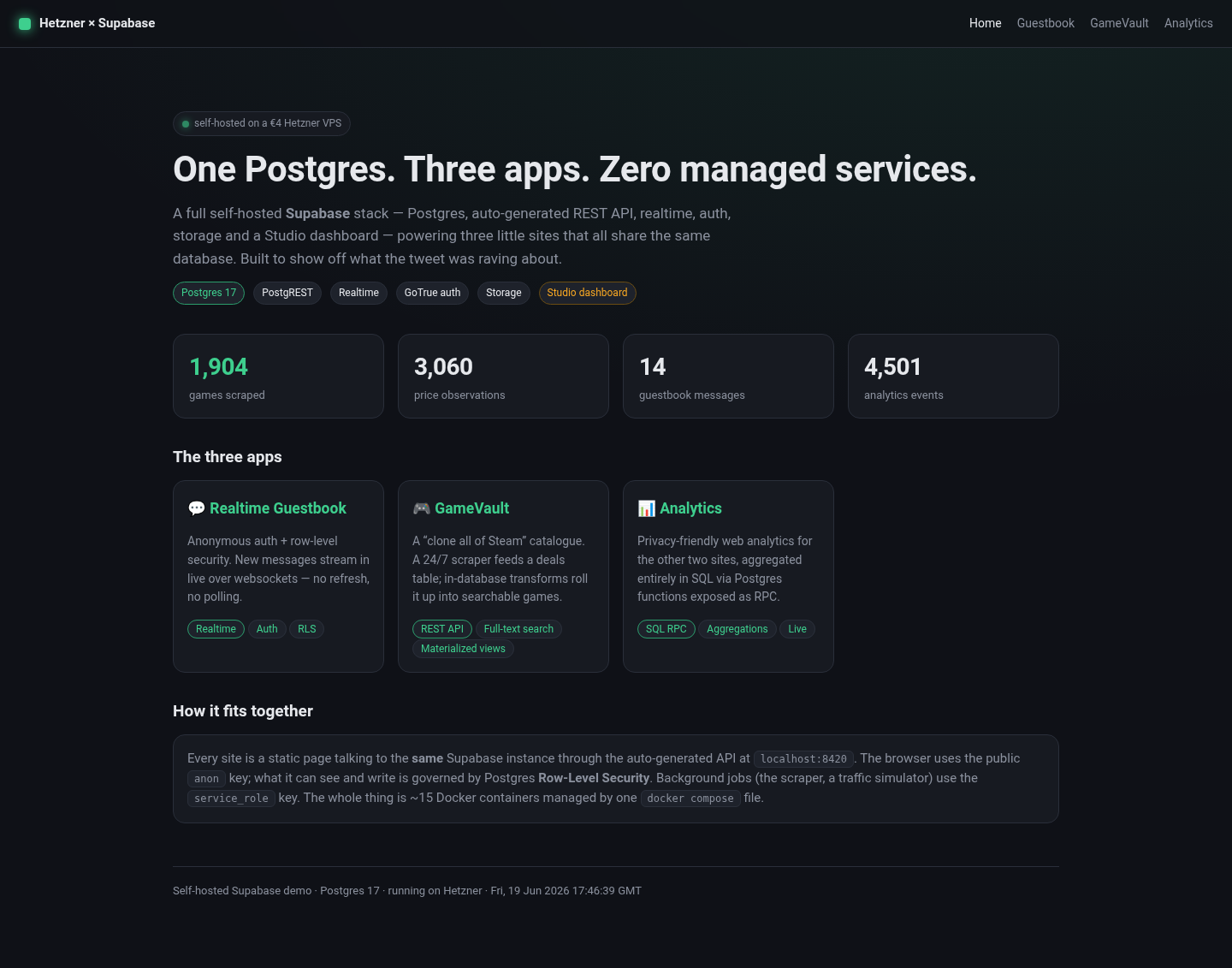
Three apps, one shared database
Every site is a static page talking to the same Supabase instance through its
auto-generated API. No bespoke backend code.
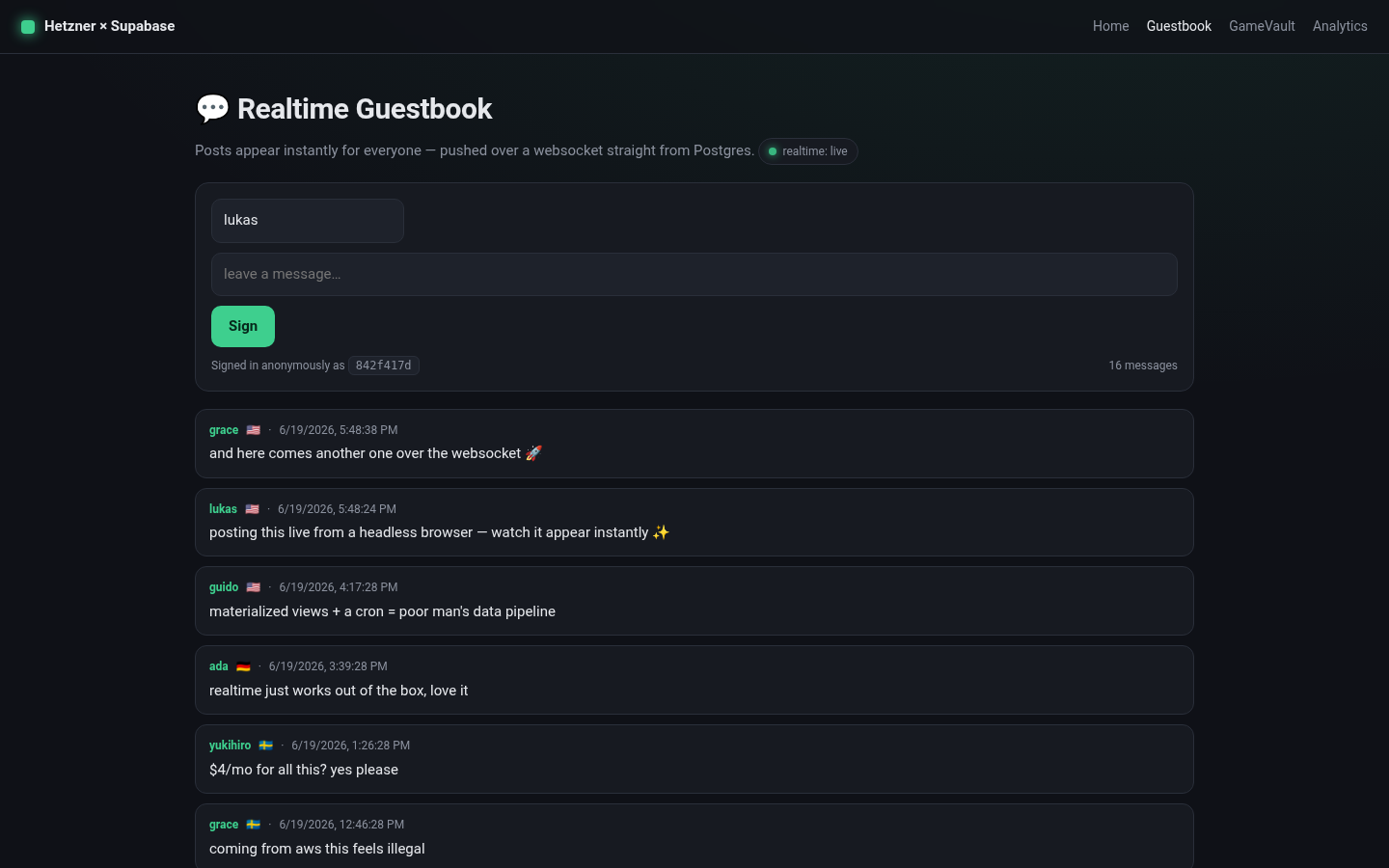
💬
Realtime Guestbook
Anonymous auth + row-level security. Messages stream to every visitor live over websockets.
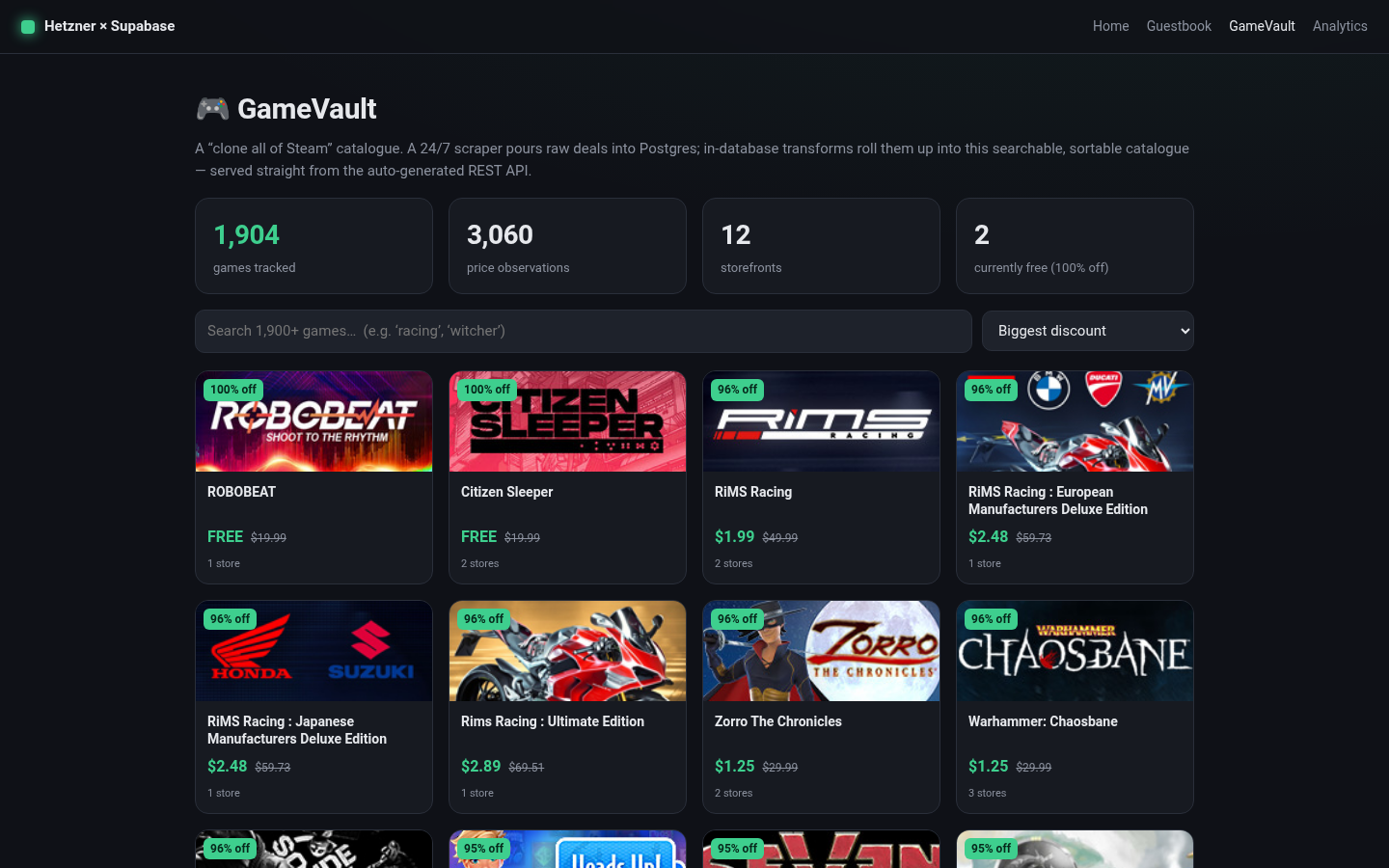
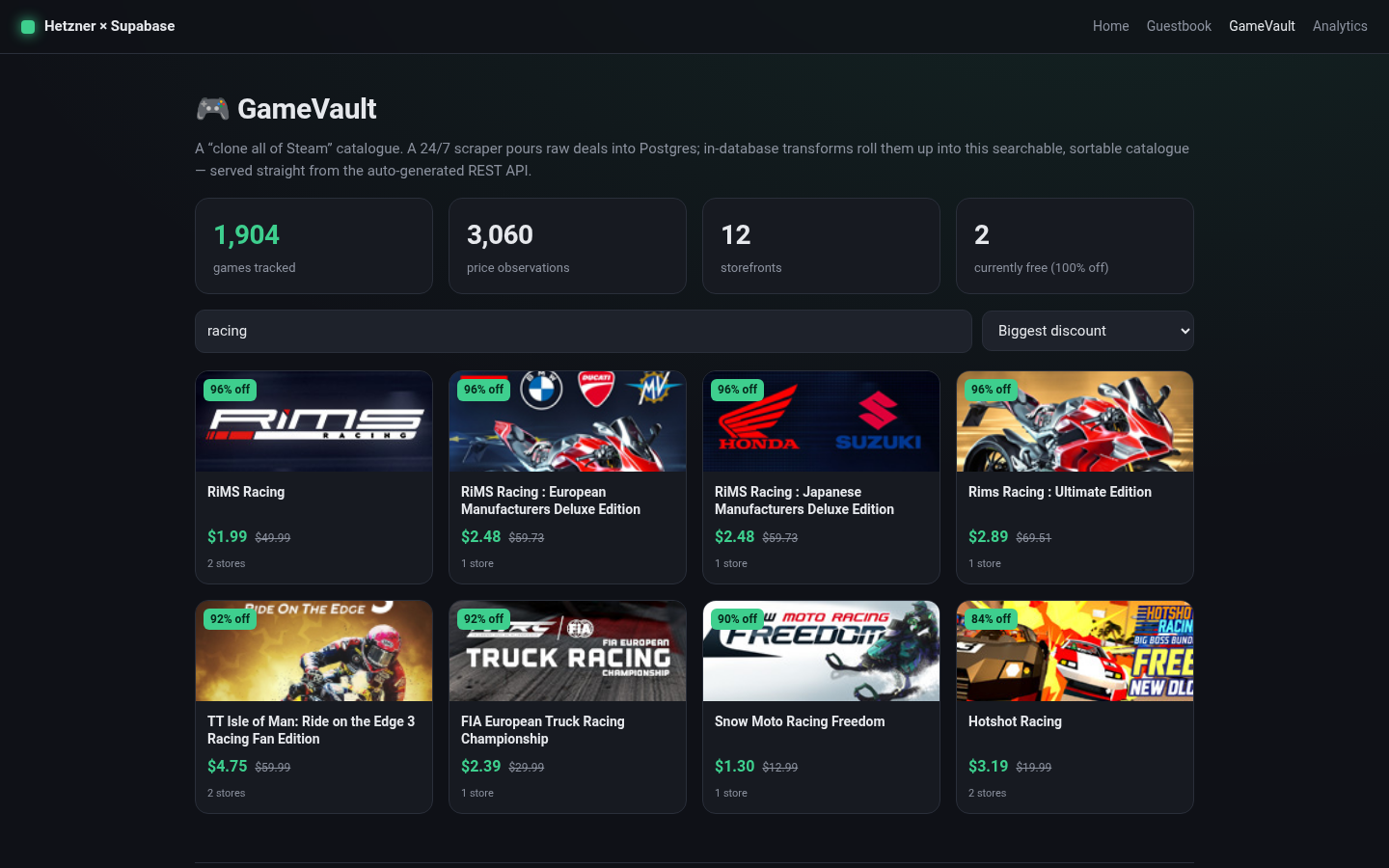
🎮
GameVault
A “clone Steam” catalogue. A 24/7 scraper feeds a deals table; in-DB transforms roll it up.
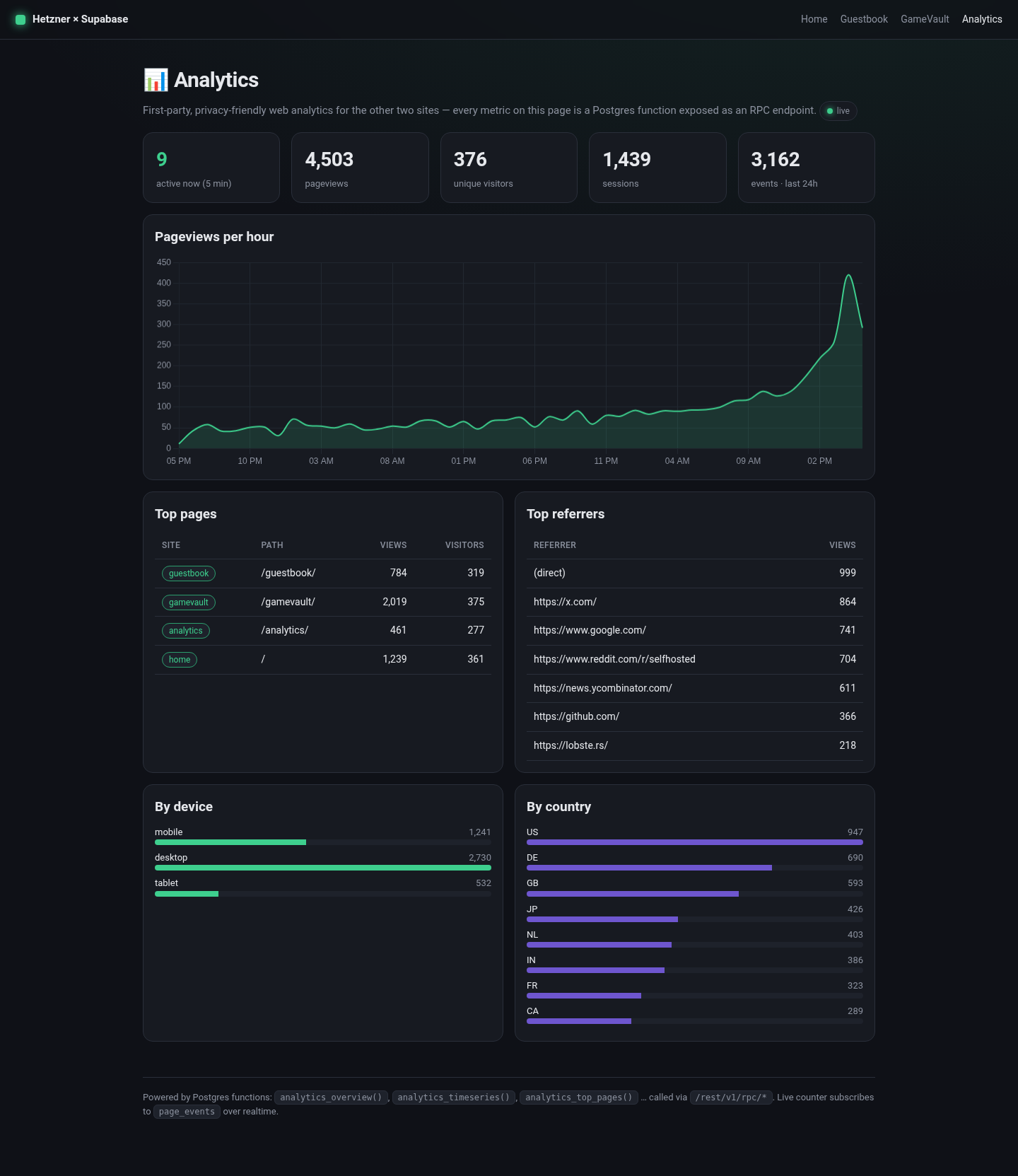
📊
Analytics
First-party web analytics for the other two sites — every metric is a SQL function over Postgres.
the cluster
The front door
A landing page that pulls live counts straight from Postgres via the REST API.
1,904 games · 3,060 price observations · 4,500+ analytics events.
All three apps share one database, one auth system, one dashboard.
supabase-jsanon key + RLS
the footprint
The whole platform is ~15 containers and one compose file
11
containers in the core stack
2.3 GiB
total RAM used, idle-ish
1
docker compose up -d
€4/mo
class of VPS this runs on
Postgres, PostgREST, GoTrue (auth), Realtime, Storage, imgproxy, Kong gateway, Supavisor pooler, pg-meta, Edge Functions and Studio.
Fresh secrets, remapped ports — dropped onto a box already running a dozen other services.
It’s just Postgres underneath. Everything else is a thin layer over SQL.
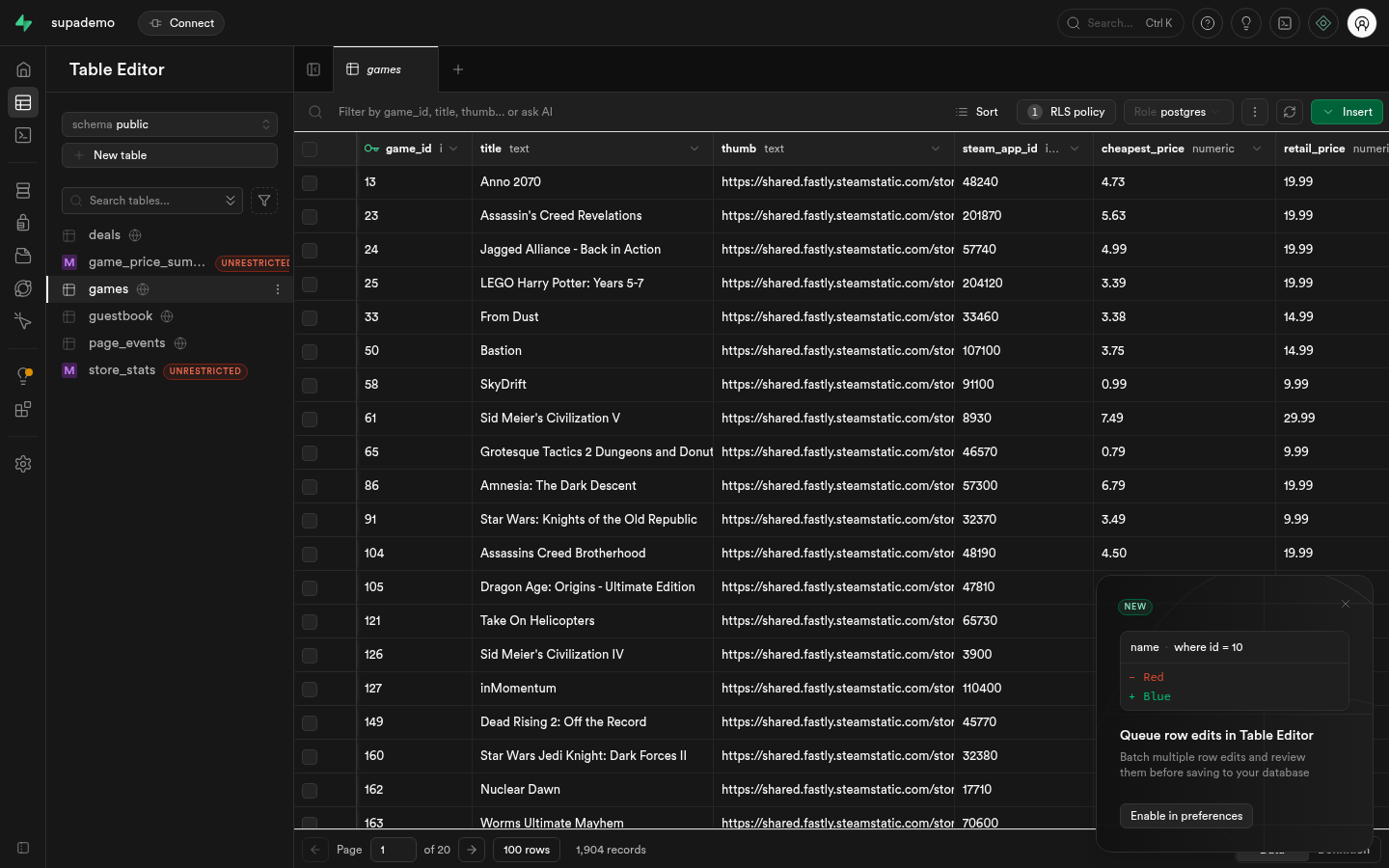
Browse, filter and edit the 1,904-row games table like a spreadsheet.
Real foreign keys, types and constraints — surfaced visually.
Add columns, rows or relationships without touching SQL.
studio · sql editor
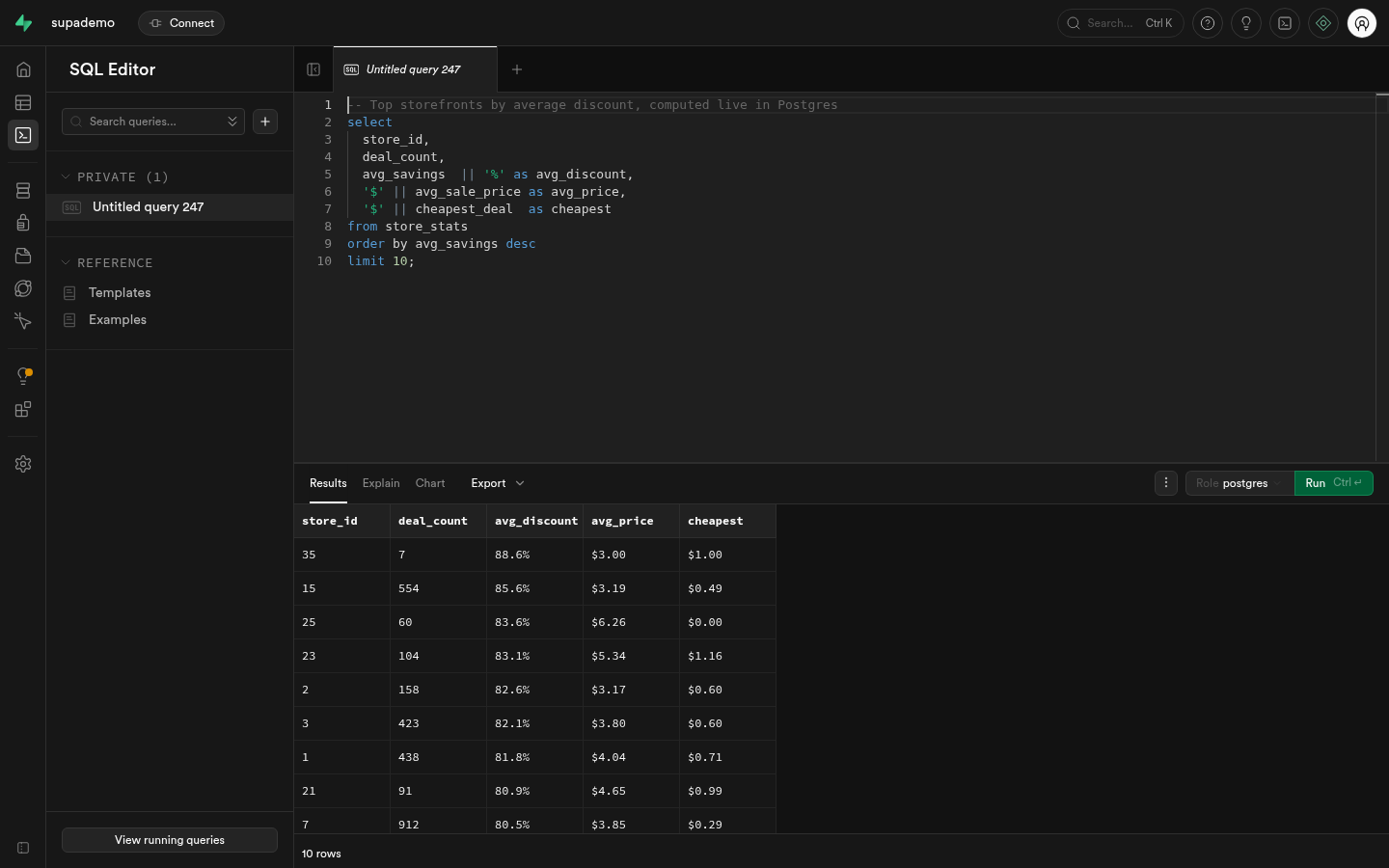
Full SQL, with results inline
A real query console — here ranking storefronts by average discount across all deals.
Save queries, chart results, explain plans, export to CSV.
This is the “constant data transformation” the tweet talked about — just SQL.
studio · authentication
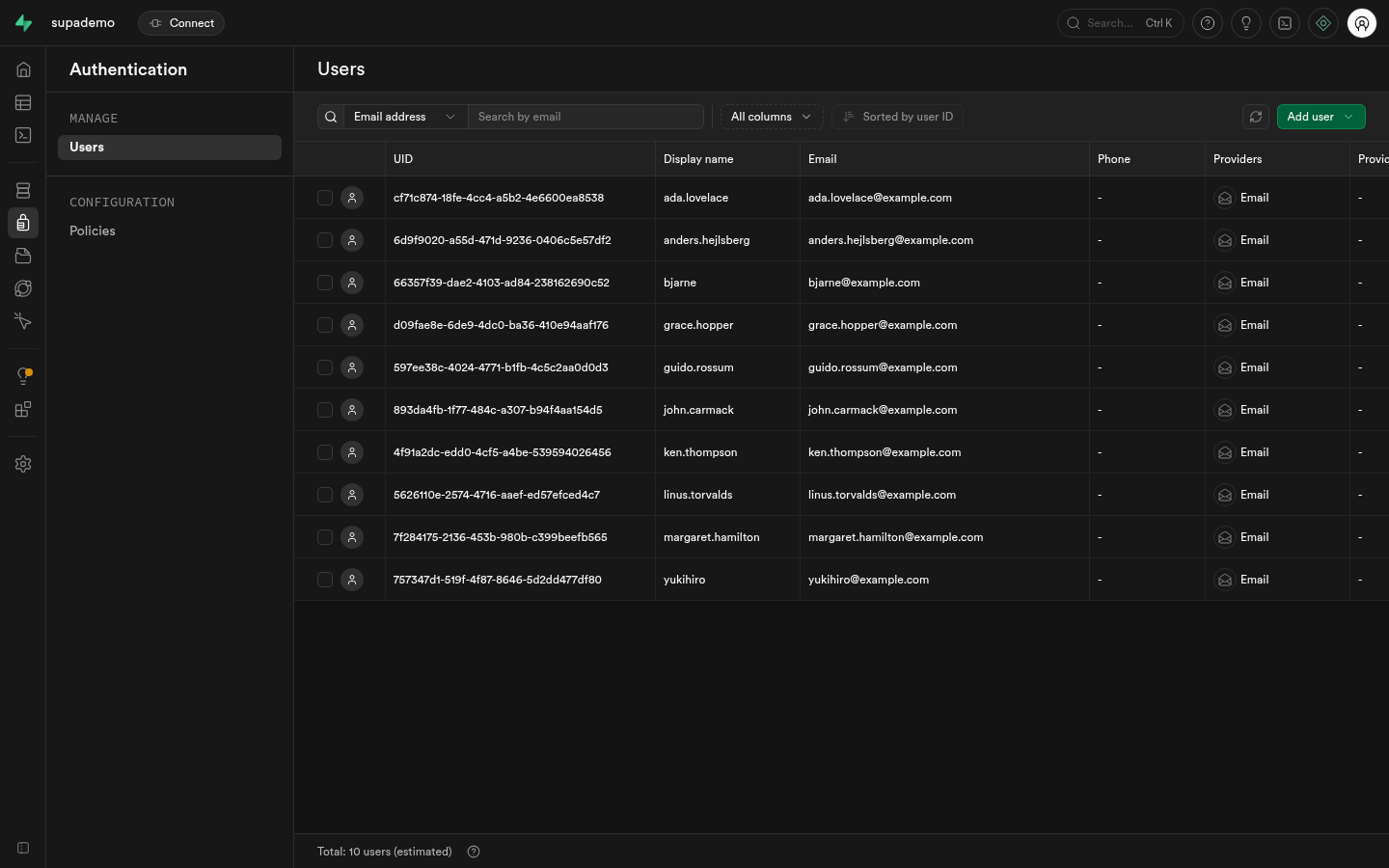
A users table you don’t have to build
Email, OAuth, phone, magic-link and anonymous auth — all included.
10 demo users created here via the admin API in seconds.
JWTs flow straight into RLS policies, so auth and authorization are one system.
studio · database & advisors
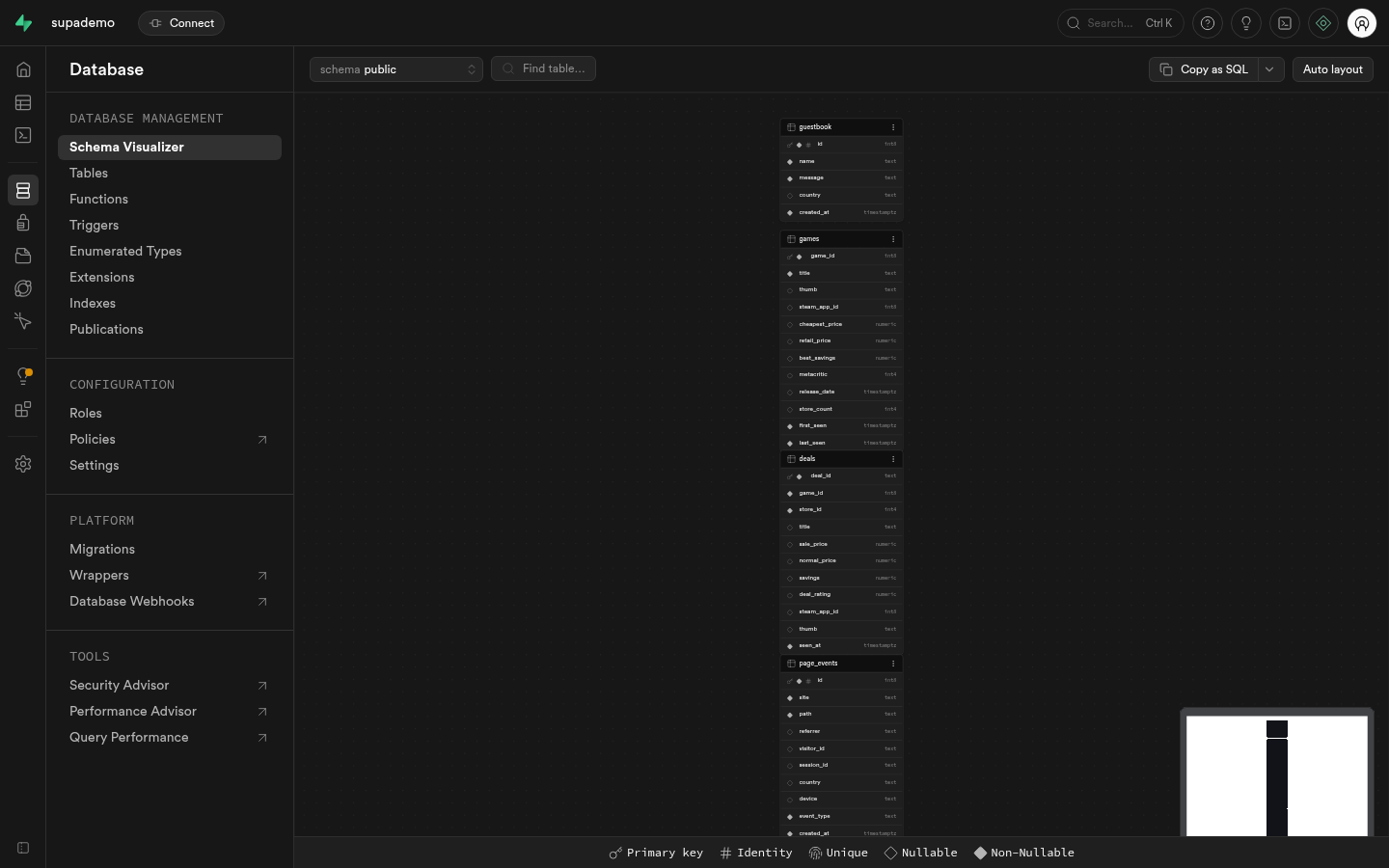
See the schema, mind the guardrails
A live schema visualizer of all four tables, keys and column types.
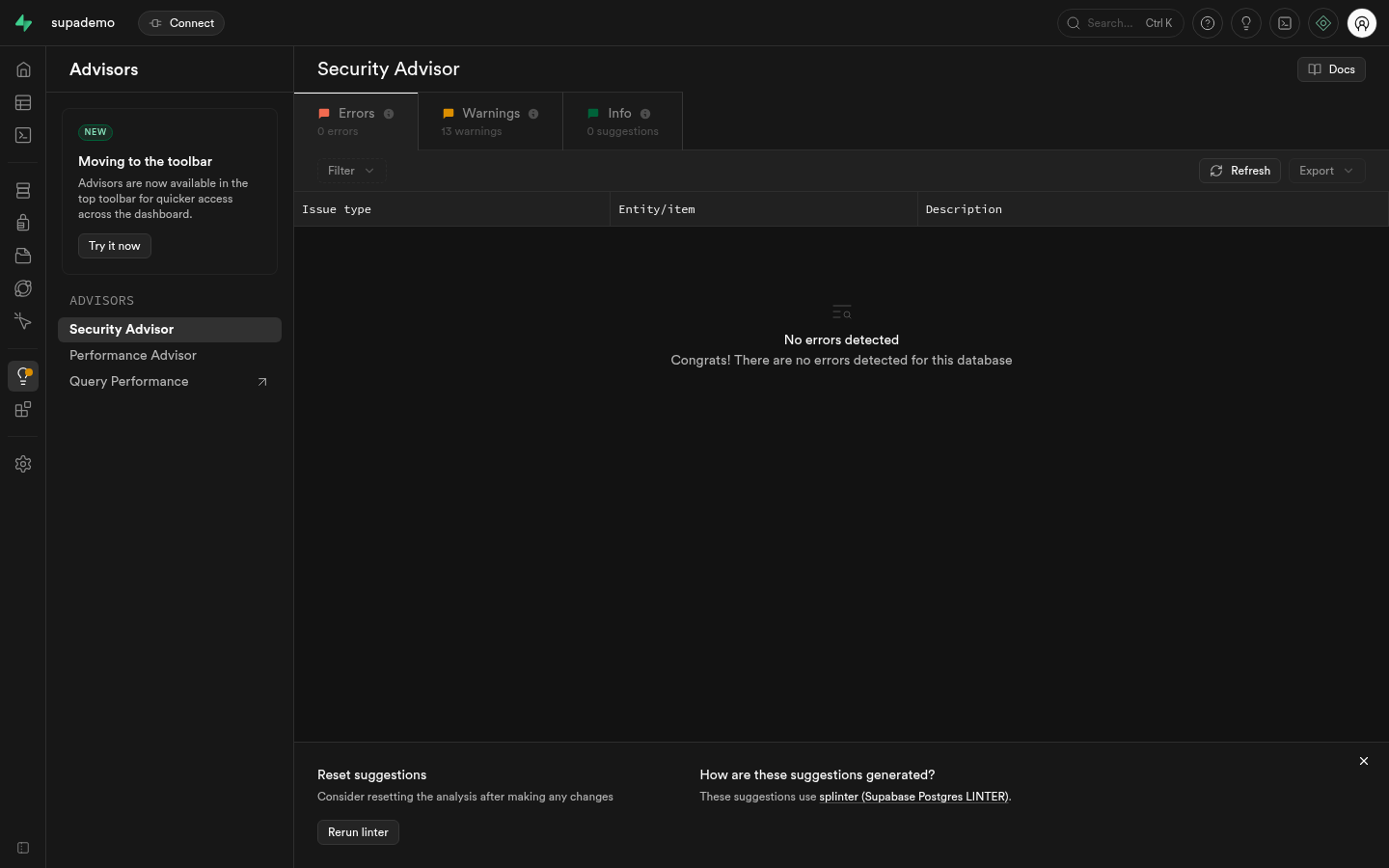
The Security Advisor lints the database — 0 errors here, because RLS is on everywhere.
Performance advisor + query stats round out the ops story.
studio · security advisor
It tells you when you’ve left a door open
Automated security lints across every table and function.
Catches the classic foot-gun: a table exposed to the API without RLS.
Here: 0 errors — every table has row-level security enabled.
studio · connect
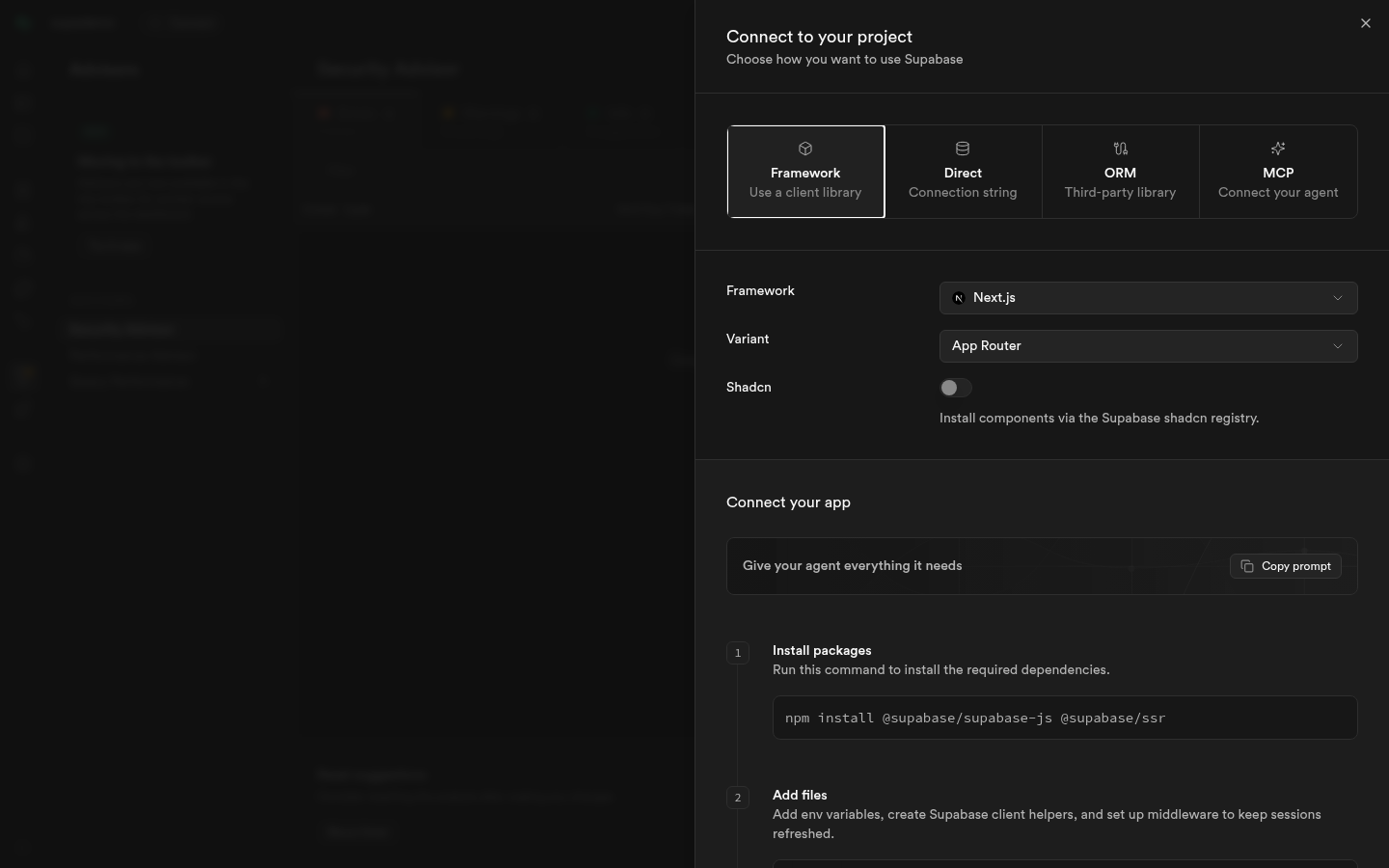
Wiring up a new app is copy-paste
Ready-made snippets for Next.js, React, Flutter, and more.
Direct connection strings, ORM configs, even an MCP endpoint for AI agents.
This is how all three demo apps got connected — npm i @supabase/supabase-js and go.
the takeaway
Why this is genuinely useful
🧱
One box, many apps
A single Postgres instance backs every side-project, each isolated by schema + RLS. No per-app infra.
⚡
Backend for free
REST API, auth, realtime and storage appear the moment you create a table. You write SQL, not glue.
💸
Flat, tiny cost
No per-request billing, no cold starts, no surprise invoices. It’s a VPS you already pay for.
🛠️
It’s just Postgres
Extensions, triggers, materialized views, cron — the full toolbox, not a walled-garden subset.
🔍
A real dashboard
Studio makes inspecting and editing data pleasant — the bit Firebase/AWS consoles get wrong.
🚪
No lock-in
Standard Postgres + open-source services. Dump it, move it, run it anywhere.
verdict
The tweet was right.
A €4 VPS now runs a full backend platform and three apps and analytics and a 24/7 scraper —
all from one Postgres database, with a dashboard that’s genuinely a joy to use.